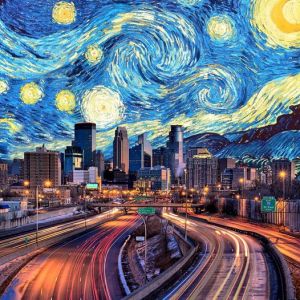
So here it is a Saturday afternoon. It’s cold outside, we had our first snowfall yesterday, and Thanksgiving is next week. Typically these are the darkest days of the year for me, both literally and figuratively.
In the literal sense, well… that should be self-explanatory. I can’t say with certainty that I have seasonal affective disorder but the symptoms which develop this time of year are similar. Generally, I feel depressed and anxious. More specifically, there is a sense of hopelessness and foreboding.
However, it is possible that darker days correlate to the upcoming holiday season, which unfortunately has more often than not been experienced as a burden rather than a joyous time to spend with family and friends. My earliest memories recollect Thanksgiving and Christmas spent at my grandparents, with all my aunts and cousins there. Food, drinks, and laughter abounded. The children, including myself, were constantly in motion, building blanket forts in the basement and playing indoor tag, much to the chagrin of the adults. These were categorically happy times…
After moving to the suburban city at age 10 and the subsequent divorce of my parents, things changed. A pall was cast over those happy memories. Dad was no longer at my grandparents and a different format for “celebrating” the holidays ensued. Instead of unity there was division and I began to learn that expectations for behavior, and by extension my personality, changed according to the venue and the people in it.
With the addition of new romantic partners for each parent and their extended families, some years required four different “celebrations”; I only wanted one, that which I already knew and loved. Dad and P had a very formal, please and thank you, Christmas. Mom and B had a drunkfest and B’s family had a combination drunkfest / please and thank you Christmas. We would still go to my grandparents’ home in rural Minnesota where I felt most comfortable but the naive innocence of my young life was gone, though the complexity of that reality was not consciously understood. All I knew was that I didn’t feel as though I could be me; I tried to conform to what others wanted me to be.
As distress over the loss of family stability began to manifest in chemical use, poor school performance, and legal trouble, the feelings of identity alienation became more apparent when contrasting experiences from each distinct and separate family unit. I compensated by trying to conform even more to what others wanted of me. By the time I reached adulthood, the coming holiday season would bring dread along with it.
There have been periods where the opposite was true, most notably when I was married and my daughter was younger. In those times a feeling of being connected and a sense of patriarchal duties gave the holidays meaning, though my identity was still based on falsehoods and was built as a means to protect my soft and sensitive inner core. In those years I felt others viewed me as a success and I felt accepted, even if I didn’t accept myself.
The loss of everything that held up the facade including my ex-wife, business success, money, and possessions, has left bare what was underneath. But that is the best thing that could ever have happened. I shudder to think what the next 40 years may have looked like had the pain experienced not jolted me towards spiritual redemption. All I can do now is be honest and show myself for what I am. And just what I am, I am truly learning for the first time. Great fear existed for what I might find underneath the facade because of the illusion believed by using other people as a mirror of my soul.
It’s like standing at the edge of an opaque pool of liquid near a volcanic hotspot. You don’t know how deep it is, what temperature it is, the poisons that might be hidden in it’s chemical structure, whether the bottom is soft sand or sharp rocks, or what demonic creatures might be lurking within. At first you gingerly stick a toe in to test the temperature and make sure there is no reaction on your skin. Next, you place your foot in to test whether the bottom is sound. Gradually you begin to submerge your entire body, the pace of which accelerates as you grow more comfortable believing nothing bad will happen. Exploring first the edges of the pool, keeping your head just above in order to breath, the point comes when you are no longer touching bottom and, finding yourself in the middle of it, your eyes fervently dart around to find an easy escape route in case it were needed. Faith grows to the point that curiosity and excitement outweigh fear and you dive below the surface, feeling light and free as you are unsure which direction you are going but just knowing, knowing, that it feels right.
Either that or you accidentally fall in like the guy at Yellowstone, and the boiling hot, acidic water eats away everything but your clothes. Poor guy…
Levity.
 Blended Vertices