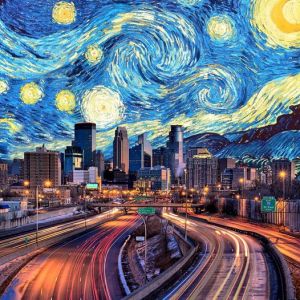
I was born in a small town in western Minnesota that was comprised almost entirely of descendants of northern European immigrants. It was a farming community, the people were friendly, and the steeple of the Lutheran church loomed large in both the literal and figurative sense. The church itself was a grand structure, having been built in the late 1800’s. My immediate family and I lived there for the first ten years of my life and I distinctly remember Sunday school classes and discovering that we were all sinners who could only find salvation through Jesus.
After moving to the twin cities metropolitan area in 1980, the first questions arose as to whether God was real. They didn’t stem from any one event other than a developing adolescent mind that began to compare conflicting teachings of science and Christianity. Reconciling the two was difficult and explanations of how to do so varied according to the teacher. Each end of the spectrum unequivocally taught that the other was wrong, and in the middle, efforts were made to fold one philosophy into the other.
My family exemplified the spectrum. During my early teens, the Lutheran confirmation process deemed that besides the weekly Wednesday night classes, one Sunday church service was required each month. I didn’t like attending any of it and would always wait until the last Sunday of each month to make the church service. For some reason it was important to my parents that I achieve the confirmation right-of-passage even though their own personal devotion was questionable at best, as shown by their willingness to drop me off and pick me up for the service without attending it themselves. I have an aunt and uncle who jumped on the evangelical bandwagon around this time. They both had been addicted to drugs and alcohol when they met and somewhere along the way Jesus entered their lives. Eagerly they sought to spread The Word and intrusively attempted to convert my grandparents, aunts, and my mother.
At the age of sixteen, I was placed in a 12-step treatment program for marijuana addiction and taught that I was nothing without a “Higher Power” and that only by hitting “rock bottom” and accepting that power into my heart would I be able to recover and live a prosperous life. Of course, the only spiritual practice known in my limited years involved Christianity and my evangelical aunt and uncle sought to capitalize on my predicament so they could save another soul.
I read the Bible, prayed each day, and went to services vastly different than the Lutheran version I was used to. For me, the idea of spiritual experience is extremely ambiguous even to this day. I can honestly say that something positive happened during that period, for which I am grateful. However, the questions still lingered regarding whether God was real and when those popped up, my religious education highlighted this lack of faith. For the boy who already thought he was fundamentally flawed, these feelings were more than discouraging. Rather than explore those questions objectively, it was less painful to abandon the practice.
When I first met my now ex-wife, winning her love meant validation of most of the uncertainties felt about my identity and character. Besides being intelligent and beautiful, she had very strong connections with her family, which I admired and longed for with my own parents and siblings. Her mother and father raised Suzanne in the Pentecostal tradition and she still had many of these extremely conservative viewpoints.. In placing her high on the pedestal of redemption for my low self-esteem, it was easy to fall back into my evangelical experience and adopt those same viewpoints as guiding principals. It proved to be deceptive not only for self-truth but also to her. But in wanting to follow a path of commitment and devotion, in reality towards her rather than any deity, sobriety of four years was celebrated and it was the most outwardly productive period of my life. It showed what was possible without self-destructive behavior even if the accomplishments never penetrated the facade enough to change negative core beliefs. In hindsight it is easy to see how I felt like an impostor; at any moment the jig might be up and exposure of the flawed, non-believing sinner would rip the scab from the old, shameful wound of overall deficiency. With this fear of exposure as the dominant guide for behavior in my marriage, it became a self-fulfilling prophecy in 2010 and the marriage crumbled as descent back into addiction took hold.
I’ve always struggled with the thinly-veiled Christian dogma of AA. AA works for many, many people and my beliefs are in no way an attempt to disparage the love, encouragement, sense of community, and overall success that others have experienced through participation in that program. While I have had great experiences in AA, the framework of the program as a means to stay sober have failed me. The first response to that statement by the avid AAer might be along the lines of “you haven’t worked the program hard enough”, or “you haven’t truly accepted that you are powerless”. For me, therein lies the problem.
My argument regarding the Christian aspect of this program can be summarized as follows: what other mental health condition, as defined in the Diagnostic and Statistical Manual of Mental Disorders, has at its prescriptive core the idea that powerlessness must be accepted, a higher power must be believed in, a moral inventory must be taken (is it a moral problem or a disease?), etc. etc. until a spiritual awakening has finally been experienced in step 12? The meetings start and end with a prayer. There is a single book that is revered to the point of being holy. And perhaps most discouraging for me, if any dissent from the framework of the steps is expressed, it means the dissenter is in “denial” and is bound to relapse lest he try harder to get his mind right.
So this time around I’m trying something different. I am comfortable calling myself an atheist and do so in the broadest sense of the word in that I believe no deities exist. However, there are fundamental concepts that I believe are required for me to stay sober, and on a broader, philosophical level are required for the vast majority of the population to live meaningful lives.
Let me state that I would currently classify myself as a naturalist, meaning that there are a set of principles which govern the order of things but that all of those are natural, biological, and scientific in nature. Human beings have no supernatural authority over any other living thing, be it a plant, bird, or bacteria. All living things are here by natural selection and this time we are alive is all we have; there is no afterlife.
Functioning communities are what have allowed human beings to thrive as a species. The earth is 4.5 billion years old and science has shown that the first creature to walk on 2 legs existed only 4 million years ago. If we even want to call that first creature remotely human, that means we’ve been here only 0.1% of the time our planet has existed. Somewhere during that evolutionary process, maybe a few hundred thousand years ago, banding together made more sense for survival than did going it alone. Even now, we see other species flocking together for a greater chance at survival (think birds flying south in the winter, or wolves or lions). It makes sense that human beings have a biological precedent of living in communities. Hunting, gathering food, and staying warm are all easier when we do it together.
Addiction allows for a dissociation from our biological needs. When I am sober and alone, I am uncomfortable to the point that I am motivated to do something about it. When I can get high or drunk, it is easy to be alone. So even as a naturalist, my involvement in a community is necessary to stay sober and survive. As alluded to in several other posts, it is still difficult for me to abandon fear and go into an unknown social situation but I have accepted that this is necessary.
Another practice of AA that I believe important in my recovery is found in the 11th step, where it says “sought through prayer and meditation to improve our conscious contact with God as we understood him…”. Meditation has proven to be a remarkable addition to my recovery program. It is hard to explain to those who haven’t done it, but my daily meditations are now 20 minutes. It seems that the first half of those sessions involves calming my mind and gradually slowing down the thoughts that come at me from all directions. By paying attention to the thoughts but not indulging in them, patterns start to become apparent and themes of subconscious motivation are brought to a conscious level. Once that has occurred, I can dismiss those themes. When that happens, there are very brief moments experienced that I would define as “clarity”. In those moments I am neither defined or identified by events from the past or predestined to any outcome in the future. In remembering those moments I can dispute self-destructive thoughts and patterns that come back again as the day goes on.
By really believing that I am not defined by what I have or have not done in the past, along with the existential principle that the full responsibility of the life I call my own rests solely on me, a sense of freedom is felt unlike anything felt before. This life is not a trial run for the afterlife, this is all we’ve got. For me, addiction absolves me of taking real responsibility for my life. If I am experiencing pleasurable feelings, it becomes easy to let time pass without motivation to make the most of it. By using the disease of addiction as an excuse, it becomes easy to fall into the same trap as the Christian who believes on a fundamental level that they are a sinner destined to sin. Confession and repentance is all that is required to make things right.
This has been a long post but one that I’ve wanted to write about for a long time. I can’t say that it came out exactly as expected but it’s a start. For me, themes of naturalism, existentialism, and Buddhism are all swimming around in my head. I’ve explored all of them to some degree but none of them on a deep level. Meditation seems to tie them all together in a way I can’t fully articulate at the moment. Tonight I am going to try a new meeting called Refuge Recovery, which is based of Buddhist principles. In researching it earlier this weekend, apparently the founder of the movement has recently gotten into trouble because of sexual impropriety. Given how excited I was to learn about this AA alternative, it was disheartening to see this blemish on a great idea that could fill a personal void that has existed for a long, long time.
But then I remembered that life is an ongoing process of change, with ongoing difficulties. Not just for me but for everyone.
 Blended Vertices