It is very likely I will be quitting my job to start a new one, but this time as a part-owner. I am anxious about it but also excited. It has been a long time coming. Ten years ago arrogance lied and said the world was at my feet. Great success had been experienced in many areas of life: college, business, and in the social connections who considered me capable, sincere, and worthy. The primary hindrance to continued success was self-loathing, which had never gone away and existed just below the surface of the facade presented to the world. As accomplishments grew so did the fear of it all crashing down, thereby exposing me as the incompetent fraud I felt I really was.
My latest philosopher crush is Jean Paul Sartre. Certain themes have contributed to those explored with Nietzsche. Hope and progress ensues towards a path away from the morass of shame and doubt. Particularly helpful have been the ideas that existence precedes essence, refraining from objectivity in terms of the labels we apply to ourselves and others, and living in bad faith.
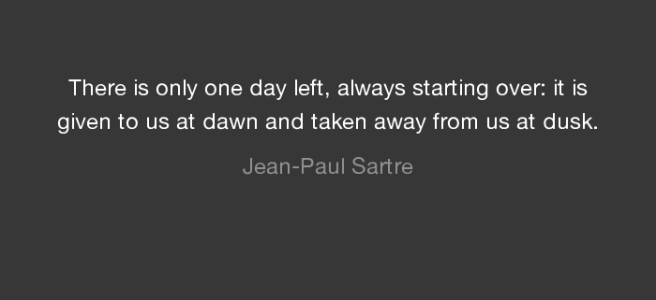
My future is not determined by my past. This includes past actions as well as thoughts and emotions. Every day I wake up with complete freedom of choice. If I choose to be dispirited and gruff, which will happen from time to time, accepting responsibility for this choice helps free me from making derogatory self-judgments. If I falsely believe this to be my natural disposition, then each day begins with preconceptions that will influence attitude and behavior. Conversely, choice that leads to positive consequences must be met with the same critical, and humble, examination. Each day is nothing but a series of isolated choices that has no affect on opportunity which inherently exists the following day, the day after that, and every day thereafter.
Not only does the power exist to challenge the way past experience influences expectations of the future, so too does it exist in my ability to react in the moment. If reality is perceived as fundamentally unfair and a victim mentality is assumed, then an objective label is applied to others I interact with. Surrendering to a perception that negative (or positive) experiences in the world are outside of my control, and thus are being controlled or influenced by others who place their own self interests first, completely nullifies the absolute freedom of choice at my disposal. This social pressure causes a member of the herd (borrowing from Neitzsche) to conform to the objective labels applied to him or her and participation in life becomes inauthentic. Sartre calls this “Bad Faith”. Personal experience with objective labels and bad faith can best be exemplified in two ways: addiction and physical appearance.
I am coming to the conclusion that a portion of my significant substance abuse issues have resulted from labels applied to those afflicted with this problem. “It’s a progressive disease.” “Once the alcoholic starts drinking, he can’t stop.” “Once an addict, always an addict.” Accepting these statements as absolute truth predetermines what will happen when I use chemicals and they were first heard and encoded on my identity during my first treatment at the age of fifteen in the mid-1980’s. My father found a marijuana pipe and the immediate reaction was to place me in an in-patient program that was supposed to last four months. A counselor in this program who I’ll never forget, named Jack, was a crotchety old Vietnam vet and former heroin addict who used to yell and belittle us into accepting his truth as our truth. Upon leaving this place, my identity label had changed from smart and capable to fearful addict and at this point, substance use went from occasional to chronic. Based off the false ideas hammered into an impressionable teenage mind, this is what was supposed to happen.
The same course of thought flows through traditional 12-step programs. “If you don’t go to meetings, you are going to relapse.” The difficulty experienced in believing that a higher power would somehow save me from the disease that would ultimately lead to “jail or death” if left unchecked never clicked with me. Self-comparisons with others who supposedly practiced higher power worship with great success only deepened feelings of inadequacy. My “disease was doing push-ups”, just waiting for me to slip-up. This disempowering falsehood invariably led back to the bottle and the heavy use that was supposedly predestined by my condition.
Another label that’s led to bad faith has to do with physical appearance. I like to lift weights and my genetics allow to me to be good at it. In our society a tall, muscular male creates impressions of machismo, imperviousness, and severity. Exhibiting intellectual curiosity (especially as they relate to art and aesthetics) and sensitivity run antithetical to the former characteristics described. It has often been perceived that exhibiting the latter in social circles has met with smug chuckles and disguised ridicule. Inauthentic interactions consequently ensued, leading to dissatisfaction and isolation.
Studying the great philosophers has shown how subjective the idea of truth really is and that letting go of labels I apply to myself and others reduces fear and opens up a fascinating exploration of what constitutes an authentic life. The fear of making a choice followed by another choice leads to bad faith; my essence is not defined by the events of the past but instead is redefined through every choice made. Essence is only complete upon death. Fulfillment and purpose are not dictated by society directly, how I see myself in the mirror of society, or even by vain fantasies comprised of what or who I think I want to be.
The old maxim, it is better to have tried and failed than to never have tried at all, sums up this post quite well. Either we succeed in a goal or we fail, whether that goal is exercise, sobriety, a new business, or simply making a choice to be authentic in some seemingly mundane aspect of our lives. Question truth, especially as an imposition of your own beliefs and those of others.
 Blended Vertices