I Think,Therefore I Am Not

It is very likely I will be quitting my job to start a new one, but this time as a part-owner. I am anxious about it but also excited. It has been a long time coming. Ten years ago arrogance lied and said the world was at my feet. Great success had been experienced in many areas of life: college, business, and in the social connections who considered me capable, sincere, and worthy. The primary hindrance to continued success was self-loathing, which had never gone away and existed just below the surface of the facade presented to the world. As accomplishments grew so did the fear of it all crashing down, thereby exposing me as the incompetent fraud I felt I really was.

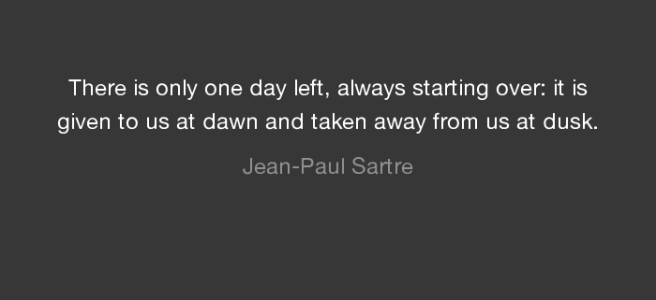
My latest philosopher crush is Jean Paul Sartre. Certain themes have contributed to those explored with Nietzsche. Hope and progress ensues towards a path away from the morass of shame and doubt. Particularly helpful have been the ideas that existence precedes essence, refraining from objectivity in terms of the labels we apply to ourselves and others, and living in bad faith.

My future is not determined by my past. This includes past actions as well as thoughts and emotions. Every day I wake up with complete freedom of choice. If I choose to be dispirited and gruff, which will happen from time to time, accepting responsibility for this choice helps free me from making derogatory self-judgments. If I falsely believe this to be my natural disposition, then each day begins with preconceptions that will influence attitude and behavior. Conversely, choice that leads to positive consequences must be met with the same critical, and humble, examination. Each day is nothing but a series of isolated choices that has no affect on opportunity which inherently exists the following day, the day after that, and every day thereafter.

Not only does the power exist to challenge the way past experience influences expectations of the future, so too does it exist in my ability to react in the moment. If reality is perceived as fundamentally unfair and a victim mentality is assumed, then an objective label is applied to others I interact with. Surrendering to a perception that negative (or positive) experiences in the world are outside of my control, and thus are being controlled or influenced by others who place their own self interests first, completely nullifies the absolute freedom of choice at my disposal. This social pressure causes a member of the herd (borrowing from Neitzsche) to conform to the objective labels applied to him or her and participation in life becomes inauthentic. Sartre calls this “Bad Faith”. Personal experience with objective labels and bad faith can best be exemplified in two ways: addiction and physical appearance.

I am coming to the conclusion that a portion of my significant substance abuse issues have resulted from labels applied to those afflicted with this problem. “It’s a progressive disease.” “Once the alcoholic starts drinking, he can’t stop.” “Once an addict, always an addict.” Accepting these statements as absolute truth predetermines what will happen when I use chemicals and they were first heard and encoded on my identity during my first treatment at the age of fifteen in the mid-1980’s. My father found a marijuana pipe and the immediate reaction was to place me in an in-patient program that was supposed to last four months. A counselor in this program who I’ll never forget, named Jack, was a crotchety old Vietnam vet and former heroin addict who used to yell and belittle us into accepting his truth as our truth. Upon leaving this place, my identity label had changed from smart and capable to fearful addict and at this point, substance use went from occasional to chronic. Based off the false ideas hammered into an impressionable teenage mind, this is what was supposed to happen.

The same course of thought flows through traditional 12-step programs. “If you don’t go to meetings, you are going to relapse.” The difficulty experienced in believing that a higher power would somehow save me from the disease that would ultimately lead to “jail or death” if left unchecked never clicked with me. Self-comparisons with others who supposedly practiced higher power worship with great success only deepened feelings of inadequacy. My “disease was doing push-ups”, just waiting for me to slip-up. This disempowering falsehood invariably led back to the bottle and the heavy use that was supposedly predestined by my condition.

Another label that’s led to bad faith has to do with physical appearance. I like to lift weights and my genetics allow to me to be good at it. In our society a tall, muscular male creates impressions of machismo, imperviousness, and severity. Exhibiting intellectual curiosity (especially as they relate to art and aesthetics) and sensitivity run antithetical to the former characteristics described. It has often been perceived that exhibiting the latter in social circles has met with smug chuckles and disguised ridicule. Inauthentic interactions consequently ensued, leading to dissatisfaction and isolation.

Studying the great philosophers has shown how subjective the idea of truth really is and that letting go of labels I apply to myself and others reduces fear and opens up a fascinating exploration of what constitutes an authentic life. The fear of making a choice followed by another choice leads to bad faith; my essence is not defined by the events of the past but instead is redefined through every choice made. Essence is only complete upon death. Fulfillment and purpose are not dictated by society directly, how I see myself in the mirror of society, or even by vain fantasies comprised of what or who I think I want to be.

The old maxim, it is better to have tried and failed than to never have tried at all, sums up this post quite well. Either we succeed in a goal or we fail, whether that goal is exercise, sobriety, a new business, or simply making a choice to be authentic in some seemingly mundane aspect of our lives. Question truth, especially as an imposition of your own beliefs and those of others.

Me, Them, or Us

I just listened to a speaker at a local Unitarian church. This gentleman was a deconverted pastor who came to a realization in 2012 that God does not exist. This must have been a very difficult and poignant idea to bring to consciousness and embrace. Standing firm in the belief meant publicly refuting everything his life was centered around: identity, purpose, fulfillment, and community. To varying degrees, those four items are integral components of the human condition and if a contemporary paradigm is shattered, another must be built in its place. Interest in hearing this speaker stemmed from a continued search for existential truth while I try to rebuild my own life paradigm. The last item, community, resonated with me as the lack of one has been so isolating and lonely. When left exclusively to my own thoughts for too long, the plunge into self-loathing and self-sabotaging behavior is never far behind.

The concept of community as a human need has deeper meaning than simply the world one lives and operates in; a practical definition might be, participating with other human beings in shared experience and intimacy. The criteria of shared experience is easy to meet while shared intimacy can be, and has always been for me, quite elusive. Within a healthy community, intimacy is and should be exercised to varying degrees but at its core, intimacy requires trust. It involves feeling comfortable enough to show all facets of oneself, including those very shiny facets that reflect the light and the ruminative ones that absorb it.

Falling into the western societal male gender role means being tough and “manning up” to get the job done, whatever that might entail. Weakness and sensitivity are deemed feminine, only to be hidden away, buried under layer upon layer of virile manhood. When it comes to emotional fortitude, I have been weak, especially in the past but still at times today. Perceived threats to my identity, real or imagined, have elicited feelings of inadequacy and shame. Overdeveloped sensitivity to these threats creates a risk-mitigating shield of fear that prevents authentic connection. The cycle has repeated over and over.

In the past several years I have been able to openly talk about this fear and others. The more open I am about it, the more comfortable I become and the less my behavior is negatively influenced. It started with a single trusted confidant and grew to include support group members. Now a willingness exists to talk freely about it with almost anyone who will listen. Unfortunately there are few individuals, if any, where a mutually deep level of intimacy exists and I am often left wanting in attempts to communicate on a very personal level.

I still don’t trust many people to let them in to the inner sanctum of my identity. Purposely going to that level outside of a structured institutional setting would be a new endeavor and it is understood that practice is necessary; gaining proficiency allows that mistakes will be made in initial attempts. It also means dealing with the aftermath of vulnerable communication by the inevitable replaying over and over in my mind of what was said and how it may have been perceived and interpreted. But the fact is, and I know and truly believe this on an intellectual level, desensitization will occur again and the aftermath of anxiety will lessen the more often I am vulnerable.

The first step is to identify a group and consistently participate within it to find those with a similar background and/or communication style. Close relationships of any kind are built upon consistently “showing up” for the other person or persons, whether it be a structured setting or otherwise. Fits and starts are part of the modus operandi that keeps the shield in place. Since determining to set a new paradigm after coming off the latest substance relapse, which ended September 15th, 2018, I have tried alternate support groups in Refuge Recovery, SMART Recovery, and a group at the local men’s center, all of which have been attended between one and three times. As of today, I have also attended two meetings of a Humanist group. I even went back to an old AA meeting twice.

The point is, I dabble but do not commit. And this creates a vicious cycle where I remain isolated through fear, the isolation leads to feelings of terminally awkward uniqueness, which then perpetuates the fear of being exposed as awkward, which justifies my isolation, and so on and so on. The pertinent question to myself as I write this: how much internal conflict and turmoil is necessary to commit to a community, with all its flaws and human fallibility on full display?

My Friend Nietzsche

I am currently fascinated with Nietzsche. His inspirations, his influences, his life, and his convictions; I consume all I come across. (The fact he went mad at the age of 44 adds an entirely different and mysterious aspect) I am still in the first of four sections of Thus Spoke Zarathustra and every sentence is so full of knowledge that by necessity it is a slow read. Given the extensive use of metaphors and aphorisms, it helps to read summaries of all his work while trying to digest the plentiful nuggets contained within Zarathustra. While doing so, further exposure has been made to the lives and ideas of Socrates and Plato, the composer Wagner, and psychologists who were heavily influenced by Nietzsche, such as Freud and Adler. A long way from being anything beyond a neophyte, it is nonetheless important for me to document my exploration of these new and exciting ideas regarding the dimensions of human existence.

The concept of herd morality, eternal recurrence of the same, and ubermensch have been on my mind as of late and in this entry, I choose to explore these themes as they relate to my own life.

HERD MORALITY

“ ‘My brother, if you have a virtue and she is your virtue, then you have her in common with nobody’. Even naming one’s virtue would make her too common; if one must speak of her, it should be: ‘This is my good; this I love; it pleases me wholly; thus alone do I will the good. I do not will it the law of a god; I do not will it as human statute and need’ ”.

I can see how almost all of my drives and values have been derived from perceptions of what other people believe I should do, think, or say. The key component of that sentence has to do with perceptions of what other people believe. My interpretation is just that: an interpretation that may or may not be true. Whether it was my father talking about “how much potential” I have (hearing that what I was doing in the moment was not good enough), or comparing myself to people in Alcoholics Anonymous testifying for God as the source of their long sobriety time, other people have been the mirror I’ve used to measure my own worth. However it may exist in each moment of a short lifespan, studying Nietzsche has shown the freedom available to one with the courage to leave the herd, to forge his own way, and to overcome internal resistance in finding his true meaning.

Every day I see the herd going about their business through substance addiction, social media posts, and an unhealthy dependence on technology. Substance addiction is an obvious tool the herd uses to escape reality and doesn’t need to be expounded upon here. Addiction can manifest itself in many ways and social media is no exception. I used to have nearly 1,000 “friends” on Facebook and after scrolling through the newsfeed, a feeling of depression would typically follow. Posts frequently showed the herd at the nightclub, on vacation, or highlighting expensive new homes and vehicles. My life didn’t seem to measure up. After cutting the “friends” to around 250 people who I actually want to engage with, the newsfeed experience is much more enjoyable and relevant.

It is amazing how much time can be spent in front of a 55″ high-definition TV. After cutting the cord on cable a year ago, I’ve since picked up subscriptions to YouTube TV, HBO, Netflix, and Amazon Prime. While my interests do gravitate more towards documentaries and other content that could be deemed educational, hours upon hours can go by while lost in an alternate reality. This is especially so when my mood is low. Lately when those moods hit, I’ve been trying to pay attention in a detached, objective manner in an attempt to isolate the self-serving and demeaning fantasy used to perpetuate it. Alfred Adler’s teleology would state that deep-seated fear of being a loser within competition of interpersonal relationships is the basis for those stories, but more on that in another post. Nietzsche would say all of it is resistance, the overcoming of which leads to self-reliance and liberation, thereby bringing with it real happiness.

ETERNAL RECURRENCE OF THE SAME

“What, if some day or night a demon were to steal after you into your loneliest loneliness and say to you: ‘This life as you now live it and have lived it, you will have to live once more and innumerable times more’ … Would you not throw yourself down and gnash your teeth and curse the demon who spoke thus? Or have you once experienced a tremendous moment when you would have answered him: ‘You are a god and never have I heard anything more divine’.”

I am currently on a quest. The impetus for this is a relapse into addiction that ended abruptly with a DUI arrest on September 15th of this year. It is not an egotistical boast to say that I am highly intelligent and was first identified as such in the 3rd grade; my mind has always delved into deep thought and my struggles to overcome addiction have provided convenient avenues to exercise innate curiosity. During a teenage stint in treatment, I was exposed to art museums, the orchestra, and plays as part of structured, off-site programming. Participation in this programming developed into a lifelong appreciation for the arts and may or may not have occurred without my addiction battle. Treatment also was my first experience with individual psychotherapy, and those first sessions evolved into the years-long psychoanalysis completed earlier in 2018.

My affliction and the associated consequences have afforded opportunities to exercise a curious mind, which now finds itself on a quest to go beyond the religious dogma of 12-step recovery programs to identify morals and virtues that are my own. Would this endeavour even be possible had I been born without the gene that makes addiction so much more likely? Had I been born into a supportive and wealthy family, would the comforts of an easy life sparked the same intellectual curiosity I now use to my advantage? I think it unlikely.

Even before this relapse, personal thoughts and comments to others were made regarding the belief that recovery from addiction allows for a search for meaning that others outside of recovery often can’t understand. The hypothetical question was raised numerous times of whether one would take a magical pill that could somehow cure addiction. My instinctive response was always no.

In answer to Nietzsche, if I had to do it over again, I would take the addiction, the unexpected daughter that has shown me so much, the exquisitely painful divorce, and the significant financial loss ten years ago if it led to the same personal discovery and this exact same moment in time. In committing that statement to electronic paper, as I do now, the freedom sensed in Nietzsche’s work truly can be felt.

UBERMENSCH

This concept is the most confounding of the three discussed tonight. Perhaps it is because I am still so early in the reading of Zarathustra. I know it is not a biological state of being. The overcoming of resistance and the becoming of one’s true self resonates as a worthy goal. What this means in my own life I do not yet know. I believe it is never an achievement that the ubermensch is consciously aware of. Were it so, it would happen in comparison and competition with other men and thus would violate the premise of service to humankind and my own belief in naturalism (ALL life has equal value). A conscious belief of oneself as an ubermensch is malevolent manifestation of ego, not the transcendence of the last man and the slave, human states which are traps for us all. The higher man has a reverence for oneself and a humility in his own overcoming.

I will continue to simply put one foot in front of the other, and not let fear dominate my actions in life to the extent it has thus far. As stated earlier in this post, it is important for me to journal about this experience. The value in journaling is found by going back and rereading old posts and remembering. Right now, no one knows my personal identity and someday, that may change, or it may not. Either way, this blog serves as a record of my existence. If that is all I can provide to this world, then maybe that’s good enough.

Carpe Diem

Over the past 10 years, I’ve explored the concepts of existentialism, buddhism, mindfulness, and Freudian psychology. During the 5 years I was active in psychoanalysis, my therapist promoted these ideas in various ways during appointments. In doing the math, I averaged 3 weekly sessions and thus, over the course of 5 years, I completed roughly 600 sessions. There is no question that my psychological knowledge increased as a result. During my lifetime, I’ve always been ‘psychologically minded’ and naturally inclined towards philosophy.

Since coming off my relapse 2 1/2 months ago, committing to a fervent exploration of these topics has taken on new urgency as continued sobriety demands it. Alcoholics Anonymous as a primary framework for recovery just hasn’t worked for me but SOMETHING has to be substituted if I am going to make a go of this and enjoy a fulfilling life.

In questioning AA as it relates to me, there has been a nagging sense that powerlessness and the necessity of accepting a ‘higher power’ are anathema to basic logic. Science and empirical data overwhelmingly support my personal belief that nothing supernatural exists in the universe. While medical technology continues to change at an exponential rate, for some reason the predominant method of addiction treatment hasn’t changed much in 70 years. What other mental disorder has as its prescription that one must accept and turn their will over to a higher power, create a moral inventory, ask their HP to remove defects of character, etc., etc.?

I’ve said it before and I’ll say it again. For those who find 12-step programs beneficial for their recovery, there is no judgement on my end. All I’m saying is that for someone like me, who has been struggling off and on with this major problem, it’s time to try other options.

Since September 15, 2018 I have been meditating almost daily. The cumulative effect of this has allowed for new insights into how fear has controlled my behavior. Borrowing a line from AA, I have lived life with regrets about the past and worries about the future. Usually at least once during each meditation session, brief moments of clarity have occurred where none of that matters. In those moments, a sense of freedom like I’ve never experienced before envelopes me. Because this takes place during a conscious effort, that effort being the meditation session itself, affirmation that it can be controlled takes hold.

Buddhism and the mindfulness approach have given a name and framework to my meditation practice. The first introduction to these concepts and anything related to philosophy took place over 20 years ago when I read Zen and the Art of Motorcycle Maintenance. I was really young when I read it and it was hard to understand. But something kept me from discarding the book and when finished, it had affected me somehow in some way that couldn’t be articulated. The discussion of Quality wasn’t really about traditional Buddhism but in hindsight it is obvious that the author, Robert Pirsig, was influenced by it.

In 2004 I was required to take a philosophy course for my college general education requirements. The course was a brief overview of many different schools of thought and it was then that an affinity for the existentialists developed. The theory that there is no meaning in the world except that which we as individual, thinking human beings apply to it resonated with me. I do not profess to be any sort of existentialist expert but I’ve read excerpts from Sartre and Keirkegaard and am currently attempting to read Nietzsche’s Thus Spoke Zarathustra. Admittedly, it’s a slow read as each word was chosen so carefully by the author. Most of the time I have to reread each sentence, paragraph, and section multiple times to fully understand what Nietzsche is trying to say.

Recently in my Facebook news feed, an ad for specific audio books kept popping up and the first on the list always seemed to be The Courage to Be Disliked. The title intrigued me and after a little research I was introduced to Alfred Adler. I ordered the book and am about 1/4 of the way through it. To be honest, I feel that the combination of meditation, Nietzsche and Adler might be the Drano I’ve been looking for to remove the nasty clog blocking my psyche. In other words, a breakthrough may be underway.

Adler was a colleague of Freud (often mistakenly referred to as a student of Freud). To summarize, Adler believed that the past didn’t matter in determining one’s disposition or personality; we all have the ability to choose our ‘lifestyle’ at any given moment. Lifestyle is used in Adlerian psychology and it is translated from a German word, lebensstil, meaning ‘style of life’. Essentially lifestyle in the Adlerian sense reflects an individual’s unique, repetitive, and unconscious way or responding to the main tasks of living: friendship, love, and work.

The power to choose my own values and the mandated freedom to act authentically in pursuit of those virtues is mind-blowing. The evidence for how this manifests can be exemplified by the long weekend just experienced.

In a fundamental sense, I’ve been afraid to go out and be around people and have acted accordingly for years. My time as a part-time restaurant manager gave me a social outlet but it was inauthentic to my values. I like intimate connection and intellectual thought, discussion, and exploration. Working at a restaurant / bar with a bunch of 20-somethings is not an intellectual pursuit. Because I enjoy and long for those intellectual experiences but lack confidence due to feelings of inferiority, I’ve used avoidance to mitigate the risk of being rejected or ridiculed for expressing my deeply emotional responses to literature, art, and philosophy. For me, a deeply emotional response is simply discussing how these things affect me on a personal level. The same fear is felt when it comes to intimate connections with other people in general, whether it is a romantic relationship or a male friendship; the fear of rejection still exists.

So with the influence of Adler in my heart and the voice of Nietzsche in my head, I vowed to try something different over the past few days. Wednesday night my sister and I went to see At Eternity’s Gate, the movie that just came out about Vincent Van Gogh. 20 minutes into it my sister whispered how she thought it was terrible and proceeded to  fidget in her seat the rest of the movie. Upon hearing and watching this negative reaction, her enjoyment was taken upon myself and my own enjoyment began to suffer. I recognized those thoughts, stopped myself, and dismissed any responsibility I had to make her happy. We drove to the theater separately and I decided if she wanted to leave, she could leave. I thought Wilem Dafoe did a fantastic job conveying the angst of Van Gogh and was definitely going to stay till the end.

On Thanksgiving my mother, this same sister, and I went to an extended family gathering in western Minnesota. It was really a surprise that my mom wanted to go and in fact, I hadn’t talked to her since last May. She was the one that reached out to me as I had been AVOIDING her because I didn’t want to put up a false front in dealing with her. (I won’t go into my mom stuff here but it’s described somewhat in previous posts). I was determined to be authentic with my mom and with everyone else at the gathering. I had a lot of fun with my family and my sister decided to stay out there and ride back the following day with my cousins. On the way home it was just my mom and I and over those 2 1/2 hours I felt we connected in a way we maybe never have. It was nothing effusive or cathartic. But it was authentic and it was good.

On Friday I went to a coffee shop in Uptown to read Zarathustra. You may be thinking, so what? I realized that for some reason, I had a fear of being judged were I to go out in public and have people see me reading a book like that. So overcoming that was part 1 of the positive experience. Part 2 was just the fact that I was around other people in a venue other than work or the gym.

On Saturday morning I finally made it to my first Refuge Recovery support meeting. I talked about this Buddhist inspired addiction recovery group in a previous post but had yet to make it to one. I threw aside fear, went to it, and spoke about the fear during the group. Afterwards, I went back to the same coffee shop I went to on Friday and read Zarathustra for a few more hours.

Today I went to the Minneapolis Institute of Arts and spent considerable time examining paintings and sculpture in the way I like to do it. Usually if I go with other people (family), they spend just a few seconds in front of each piece and continue on to the next. I feel compelled to keep up and end up disappointed in the experience. Today I spent time really examining each piece of art and the nuances of each; the brush strokes, the peripheral details, and trying to understand what each artist was trying to convey before reading the descriptive placards next to them. In this way it was an exercise in mindfulness and I left feeling fulfilled, if a bit lonely due to the fact that only a fraction of the many people there were by themselves. However, it is definitely something I intend to do again as my slower pace meant only a fraction of the works on display were viewed.

So I conclude this weekend feeling very different than at the conclusion of most others during the past several years. I employed intentional effort in getting off the couch and out among other people. I took some small risks in showing authenticity and even experienced a small amount of rejection (sister and the movie). I made some new connections in a recovery support group that feels like a better fit for me. Finally, I explored my humanity and liked what I saw.

I do have fear that this is just a passing phase and I will regress back into isolation and the historical preference for emotional avoidance. But I’m hopeful because of honest cognizance of where that path leads. Ultimately it leads to relapse but before that it leads to resentment, self-pity, and feeling inferior. Wanting something different than that created enough internal conflict to the point I felt compelled to act. I have enough faith in myself to believe that tomorrow will be a new day that will have all the same opportunities as today and perhaps more.

Losing My Religion

I was born in a small town in western Minnesota that was comprised almost entirely of descendants of northern European immigrants. It was a farming community, the people were friendly, and the steeple of the Lutheran church loomed large in both the literal and figurative sense. The church itself was a grand structure, having been built in the late 1800’s. My immediate family and I lived there for the first ten years of my life and I distinctly remember Sunday school classes and discovering that we were all sinners who could only find salvation through Jesus.
After moving to the twin cities metropolitan area in 1980, the first questions arose as to whether God was real. They didn’t stem from any one event other than a developing adolescent mind that began to compare conflicting teachings of science and Christianity. Reconciling the two was difficult and explanations of how to do so varied according to the teacher. Each end of the spectrum unequivocally taught that the other was wrong, and in the middle, efforts were made to fold one philosophy into the other.
My family exemplified the spectrum. During my early teens, the Lutheran confirmation process deemed that besides the weekly Wednesday night classes, one Sunday church service was required each month. I didn’t like attending any of it and would always wait until the last Sunday of each month to make the church service. For some reason it was important to my parents that I achieve the confirmation right-of-passage even though their own personal devotion was questionable at best, as shown by their willingness to drop me off and pick me up for the service without attending it themselves. I have an aunt and uncle who jumped on the evangelical bandwagon around this time. They both had been addicted to drugs and alcohol when they met and somewhere along the way Jesus entered their lives. Eagerly they sought to spread The Word and intrusively attempted to convert my grandparents, aunts, and my mother.
At the age of sixteen, I was placed in a 12-step treatment program for marijuana addiction and taught that I was nothing without a “Higher Power” and that only by hitting “rock bottom” and accepting that power into my heart would I be able to recover and live a prosperous life. Of course, the only spiritual practice known in my limited years involved Christianity and my evangelical aunt and uncle sought to capitalize on my predicament so they could save another soul.
I read the Bible, prayed each day, and went to services vastly different than the Lutheran version I was used to. For me, the idea of spiritual experience is extremely ambiguous even to this day. I can honestly say that something positive happened during that period, for which I am grateful. However, the questions still lingered regarding whether God was real and when those popped up, my religious education highlighted this lack of faith. For the boy who already thought he was fundamentally flawed, these feelings were more than discouraging. Rather than explore those questions objectively, it was less painful to abandon the practice.
When I first met my now ex-wife, winning her love meant validation of most of the uncertainties felt about my identity and character. Besides being intelligent and beautiful, she had very strong connections with her family, which I admired and longed for with my own parents and siblings. Her mother and father raised Suzanne in the Pentecostal tradition and she still had many of these extremely conservative viewpoints.. In placing her high on the pedestal of redemption for my low self-esteem, it was easy to fall back into my evangelical experience and adopt those same viewpoints as guiding principals. It proved to be deceptive not only for self-truth but also to her. But in wanting to follow a path of commitment and devotion, in reality towards her rather than any deity, sobriety of four years was celebrated and it was the most outwardly productive period of my life. It showed what was possible without self-destructive behavior even if the accomplishments never penetrated the facade enough to change negative core beliefs. In hindsight it is easy to see how I felt like an impostor; at any moment the jig might be up and exposure of the flawed, non-believing sinner would rip the scab from the old, shameful wound of overall deficiency. With this fear of exposure as the dominant guide for behavior in my marriage, it became a self-fulfilling prophecy in 2010 and the marriage crumbled as descent back into addiction took hold.
I’ve always struggled with the thinly-veiled Christian dogma of AA. AA works for many, many people and my beliefs are in no way an attempt to disparage the love, encouragement, sense of community, and overall success that others have experienced through participation in that program. While I have had great experiences in AA, the framework of the program as a means to stay sober have failed me. The first response to that statement by the avid AAer might be along the lines of “you haven’t worked the program hard enough”, or “you haven’t truly accepted that you are powerless”. For me, therein lies the problem.
My argument regarding the Christian aspect of this program can be summarized as follows: what other mental health condition, as defined in the Diagnostic and Statistical Manual of Mental Disorders, has at its prescriptive core the idea that powerlessness must be accepted, a higher power must be believed in, a moral inventory must be taken (is it a moral problem or a disease?), etc. etc. until a spiritual awakening has finally been experienced in step 12? The meetings start and end with a prayer. There is a single book that is revered to the point of being holy. And perhaps most discouraging for me, if any dissent from the framework of the steps is expressed, it means the dissenter is in “denial” and is bound to relapse lest he try harder to get his mind right.
So this time around I’m trying something different. I am comfortable calling myself an atheist and do so in the broadest sense of the word in that I believe no deities exist. However, there are fundamental concepts that I believe are required for me to stay sober, and on a broader, philosophical level are required for the vast majority of the population to live meaningful lives.
Let me state that I would currently classify myself as a naturalist, meaning that there are a set of principles which govern the order of things but that all of those are natural, biological, and scientific in nature. Human beings have no supernatural authority over any other living thing, be it a plant, bird, or bacteria. All living things are here by natural selection and this time we are alive is all we have; there is no afterlife.
Functioning communities are what have allowed human beings to thrive as a species. The earth is 4.5 billion years old and science has shown that the first creature to walk on 2 legs existed only 4 million years ago. If we even want to call that first creature remotely human, that means we’ve been here only 0.1% of the time our planet has existed. Somewhere during that evolutionary process, maybe a few hundred thousand years ago, banding together made more sense for survival than did going it alone. Even now, we see other species flocking together for a greater chance at survival (think birds flying south in the winter, or wolves or lions). It makes sense that human beings have a biological precedent of living in communities. Hunting, gathering food, and staying warm are all easier when we do it together.
Addiction allows for a dissociation from our biological needs. When I am sober and alone, I am uncomfortable to the point that I am motivated to do something about it. When I can get high or drunk, it is easy to be alone. So even as a naturalist, my involvement in a community is necessary to stay sober and survive. As alluded to in several other posts, it is still difficult for me to abandon fear and go into an unknown social situation but I have accepted that this is necessary.
Another practice of AA that I believe important in my recovery is found in the 11th step, where it says “sought through prayer and meditation to improve our conscious contact with God as we understood him…”. Meditation has proven to be a remarkable addition to my recovery program. It is hard to explain to those who haven’t done it, but my daily meditations are now 20 minutes. It seems that the first half of those sessions involves calming my mind and gradually slowing down the thoughts that come at me from all directions. By paying attention to the thoughts but not indulging in them, patterns start to become apparent and themes of subconscious motivation are brought to a conscious level. Once that has occurred, I can dismiss those themes. When that happens, there are very brief moments experienced that I would define as “clarity”. In those moments I am neither defined or identified by events from the past or predestined to any outcome in the future. In remembering those moments I can dispute self-destructive thoughts and patterns that come back again as the day goes on.
By really believing that I am not defined by what I have or have not done in the past, along with the existential principle that the full responsibility of the life I call my own rests solely on me, a sense of freedom is felt unlike anything felt before. This life is not a trial run for the afterlife, this is all we’ve got. For me, addiction absolves me of taking real responsibility for my life. If I am experiencing pleasurable feelings, it becomes easy to let time pass without motivation to make the most of it. By using the disease of addiction as an excuse, it becomes easy to fall into the same trap as the Christian who believes on a fundamental level that they are a sinner destined to sin. Confession and repentance is all that is required to make things right.
This has been a long post but one that I’ve wanted to write about for a long time. I can’t say that it came out exactly as expected but it’s a start. For me, themes of naturalism, existentialism, and Buddhism are all swimming around in my head. I’ve explored all of them to some degree but none of them on a deep level. Meditation seems to tie them all together in a way I can’t fully articulate at the moment. Tonight I am going to try a new meeting called Refuge Recovery, which is based of Buddhist principles. In researching it earlier this weekend, apparently the founder of the movement has recently gotten into trouble because of sexual impropriety. Given how excited I was to learn about this AA alternative, it was disheartening to see this blemish on a great idea that could fill a personal void that has existed for a long, long time.
But then I remembered that life is an ongoing process of change, with ongoing difficulties. Not just for me but for everyone.

The Tangled Web of Thought

It’s been several months since I last submitted an entry. Several drafts were started but never finished. My laptop now permanently resides at the office and just happened to end up in the truck today. Sitting here on a Sunday I decided to free write and see what happens…

A depressing funk has settled into my consciousness and that surprises me. A new job was started a month ago and it has gone really, really well. Finally I can start to see an expanding horizon as I settle into the last phase of the long, steady climb out of the financial hole dug 10 years ago. What is the problem then and why do I feel this way?

I know what it is and it’s called loneliness. This new position is lucrative enough that a second job as a weekend bar and restaurant manager is no longer required. Upon quitting that people-centric social outlet a month ago, I knew the importance of promptly filling the gap. Even though I knew that, fear has taken hold and social isolation is now my reality.

I’ve been binge eating and my exercise program has fallen off the rails. Not completely vanished but the consistency that I normally maintain is not there. I feel as though I will be alone the rest of my life so what does it matter if I get fat and stay at home and watch TV. It hurts my heart to go out and see people laughing and couples holding hands.

After coming to the realization of how unhealthy even a friendship with D was, I cutoff contact. I tried Bumble and actually went on a date yesterday afternoon. I got the feeling she wasn’t into it and really, I shouldn’t be into her. There were many warning flags of a situation that I should run from. Heavy chemical use, broken home growing up, acrimonious divorce that she initiated, talking about herself the entire time, etc, etc. I think she didn’t like the fact that I don’t drink anymore. So A), why did I send her a text last night; and B), why was I depressed that she didn’t respond?

The stories I tell myself are pushing me towards an inevitable conclusion of relapse into drinking and drug addiction. I feel lonely and depressed, yet I sit home alone and feel sorry for myself because no one is texting or calling. What proactive steps do I take to make plans with people I know and to put myself in situations where I meet new people? Absolutely none. I would laugh at myself if it were funny, but it’s not. Because literally, my life hangs in the balance.

Even this weekend a few seeds of thought popped into my head regarding how much better I would feel after a few drinks. Last Sunday I went for a motorcycle ride (by myself). Passing by bars, memories of Jack Daniels flooded the senses: the smell, the taste, the feeling. Am I really fooling myself into thinking that the same cycle of relapse hasn’t already begun?

While writing, the reality of all this has become apparent. I am making a vow to you, oh great WordPress.com, to attend a meeting tomorrow night I’ve been wanting to try for some time. There are people who attend the meeting that I know casually from other meetings and the time has come to put myself out there and risk being vulnerable. The vulnerability risked is feeling nervous about being judged negatively by others, whether it is my appearance, the manner in which I speak, what I might say, or something else.

The funny thing is, I’ve never had an occurrence (when I’ve been sober at least) where I left a situation feeling like something horribly embarrassing had happened. The fear is irrational yet it controls my behavior. The fear is burned into my subconscious from events that took place as a child. Humiliation and shame consumed my adolescence. One of the main reasons I found chemicals so alluring was how they negated the anxiety that came with overwhelming fear of experiencing that shame and humiliation again.

I have accepted that suffering is an inevitable part of being human. And I know that current suffering has to do with a desire to avoid negative judgement from others. By acknowledging that action must be taken in spite of fear of negative judgement, I become willing to give up attachment to the desire to avoid judgement. I am now ready to challenge and redirect the cognitive cues that cloud the lens through which I experience the world.

Exuberance

“Under the smoke, dust all over his mouth, laughing with white teeth,
Under the terrible burden of destiny laughing as a young man laughs,
Laughing even as an ignorant fighter laughs who has never lost a battle,
Bragging and laughing that under his wrist is the pulse, and under his ribs the heart of the people,
                   Laughing!”
– From Chicago, by Carl Sandburg
I just returned from Chicago after visiting my daughter. Every time I travel there memories flood in of my first real visit to the city, in 2001. I remember feeling young, and exuberant about life. A rising star in real estate, visions of grandeur included skyscrapers built under my banner, with the rich and powerful interrupting their day to answer my important phone call. I was faithfully confident. Life was free, and easy, and seemingly under my control.
During my 2017 visit I watched the millenials cavorting around the restaurants and taverns, upwardly mobile with their trendy clothes and fast cars. They look happy and excited for what life might bring. I used to feel that way. Do I still? It’s different now. Sometimes I wish I could go back. Sometimes I’m glad I don’t have to.
I didn’t know it then, but my plan in 2001 did not correspond to Life’s plan. How often have I felt broken and lost in the past 10 years? Too many times to count. But I haven’t given up and I am grateful. So what is it? Why is my heart so heavy today?
I regret the losses and missed opportunities. I regret losing my marriage and am not sure if it possible to recapture the intensity of love I felt for Suzanne. I want my daughter to be little again and to go back, knowing what I know now, and redo it ALL. But that’s the problem, isn’t it? You can’t go back, knowing what you know now. I’m afraid that if I went back that I would repeat the same mistakes over again. It’s only through the experience of losing things that I can seem to really know how valuable they were to begin with.
But there is something that supplants the exuberance of youth and I can’t quite define it yet because I’m going through it. Of course wisdom is involved but there is something more: an appreciation for the beauty of life that isn’t in the obvious. Youth is beautiful in a tangible way. When you’re young, life is still new and wide open, bodies haven’t broken down and faces aren’t wrinkled. The intangible beauty of middle age has to do with the quality and substance of relationships, an ability to consider mortality and how we are part of something bigger.
We went to the field museum in Chicago and walked through the Evolving Planet exhibit. (The one with all the dinosaurs). Even today we are part of this story. What we experience today is the result of what others did in the past and the experience of future generations will be predicated on what we do today, and so on and so on.
I don’t want to leave this life having “tuned out” to what Life really means. I don’t have an answer and in some ways I hope I never will. It is the search for meaning that allows for fulfillment and richness of experience versus the conclusive context of meaning in itself.
“It was one of those days when it’s a minute away from snowing and there’s this electricity in the air, you can almost hear it. Right? And this bag was just dancing with me. Like a little kid begging me to play with it. For fifteen minutes. That’s the day I realized that there was this entire life behind things, and this incredibly benevolent force that wanted me to know there was no reason to be afraid, ever. Video’s a poor excuse, I know. But it helps me remember… I need to remember… Sometimes there’s so much beauty in the world, I feel like I can’t take it, and my heart is just going to cave in.”
– Quote from the character of Ricky Fitts in American Beauty

Revelation

I was going to title this post “vulnerable” and while accurate for the intended subject, I think western culture too often associates that term with some kind of weakness. Actually, the willingness to be vulnerable is a sign of strength and being emotionally expressive in a humanist sense allows for revelations about the self and the spiritual universe.

I was first exposed to the concept of vulnerability within the context of addiction recovery. Common phrases such as “being outside the comfort zone” and “having faith” are used often in the meetings of Alcoholics Anonymous and are synonymous with being vulnerable.

I’ve lived most of life believing the more shielded I was from any risk of rejection, abandonment, or criticism, the better off. Many years were spent building a facade that was meant to be protective but became isolating and selfish. Displays of anger, the emotion most often modeled by my parents during childhood, coupled with an intimidating physical presence allowed me to effectively repel perceived threats from others.  A certain gratification was felt in the moment, only to be replaced with regret and shame as I found myself alone once again. A hypersensitivity to perceived threats meant that the filter through which relationship status was evaluated allowed for very little authentic human connection.

Great artists, musicians, and writers are humanists that see the world and then create a snapshot of time, which constitutes the artist’s perception of their own reality. The painting, song, or novel isn’t a truth to be taken literally, it is merely a lens for us to look through. As a result of publishing and public exhibit, an invitation is made  for others to look through that lens and make their own determination of what constitutes truth.  The expression of who the artists are as individuals is important enough to risk possible rejection and misunderstanding by those who take the time to peer through the lens. I find their confidence in expression inspiring and laudable. To grant myself that same privilege, however, still escapes me.

We are all creative beings, and our expression takes many forms. Perceptions of existential life show up simply through our conduct and behavior; how we see the world is projected in the way we treat others. Products of relationships and human interaction in general range from biased future expectations to raising children. The true legacy we leave has nothing to do with outward appearance in the form of vanity, possessions, or esteem. Rather, it is the effect left on those that carry on in our absence.

This isn’t to say that a morose or jaded outlook predetermines those who experience it to repeat it forward in their own relationships. It is much more likely to occur though if honest expression is thwarted through defense mechanisms employed to reduce the risk of experiencing painful emotions. An abstract, inauthentic, and deflective lens is thereby created that camouflages the origin of emotion to hide it from attack. Those that look through an obscure lens are liable to see the world accordingly.

But that same lens can be cleaned and resurfaced at any time and it happens through honest emotional expression, whether that occurs in the presence of other human beings or alone. There is no denying life is hard and that making it through the trials and tribulations is what brings about an appreciation for the richness of life. That richness is an amalgamation of pain endured and joyful celebration. Being honest about the appreciation of both creates authentic selves. In my opinion authenticity transcends the average human experience and this gift embodies the ‘lens’ I refer to in this philosophical post.

I can’t entirely comprehend the fear felt in considering my own means of expression, whether it is voiced, written, or exhibited through behavior. It still terrifies to think about approaching the pretty girl I don’t know, for example. Chemical mood alteration proved very effective in mitigating this fear; now with that compensating possibility removed, I am left with only my core self. And on an intellectual, therapy-supported level, it is an undeniable fact that what lies in my essence is good, and worthwhile, and deserving of love. Writing this post is another step towards authenticity. With each small step, confidence grows into what I am becoming.